Instance Segmentation

Note
🔥 LightlyTrain now supports training DINOv3-based instance segmentation models with the EoMT architecture by Kerssies et al.!
Benchmark Results
Below we provide the models and report the validation mAP and inference latency of different DINOv3 models fine-tuned on COCO with LightlyTrain. You can check here how to use these models for further fine-tuning.
You can also explore running inference and training these models using our Colab notebook:
COCO
Implementation |
Model |
Val mAP mask |
Avg. Latency (ms) |
Params (M) |
Input Size |
|---|---|---|---|---|---|
LightlyTrain |
dinov3/vitt16-eomt-inst-coco |
25.4 |
12.7 |
6.0 |
640×640 |
LightlyTrain |
dinov3/vitt16plus-eomt-inst-coco |
27.6 |
13.3 |
7.7 |
640×640 |
LightlyTrain |
dinov3/vits16-eomt-inst-coco |
32.6 |
19.4 |
21.6 |
640×640 |
LightlyTrain |
dinov3/vitb16-eomt-inst-coco |
40.3 |
39.7 |
85.7 |
640×640 |
LightlyTrain |
dinov3/vitl16-eomt-inst-coco |
46.2 |
80.0 |
303.2 |
640×640 |
Original EoMT |
dinov3/vitl16-eomt-inst-coco |
45.9 |
- |
303.2 |
640×640 |
Training follows the protocol in the original
EoMT paper. All models are trained on the COCO
dataset with batch size 16 and learning rate 2e-4. Models using vitt16 or
vitt16plus train for 540K steps (~72 epochs). The remaining ones are trained for 90K
steps (~12 epochs). The average latency values were measured with model compilation
using torch.compile on a single NVIDIA T4 GPU with FP16 precision.
Train an Instance Segmentation Model
Training an instance segmentation model with LightlyTrain is straightforward and only requires a few lines of code. See data for more details on how to prepare your dataset.
import lightly_train

if __name__ == "__main__":
    lightly_train.train_instance_segmentation(
        out="out/my_experiment",
        model="dinov3/vitl16-eomt-inst-coco",
        data={
            "path": "my_data_dir",      # Path to dataset directory
            "train": "images/train",    # Path to training images
            "val": "images/val",        # Path to validation images
            "names": {                  # Classes in the dataset
                0: "background",
                1: "car",
                2: "bicycle",
                # ...
            },
        },
    )
During training, the best and last model weights are exported to
out/my_experiment/exported_models/, unless disabled in save_checkpoint_args:
best (highest validation mask mAP):
exported_best.ptlast:
exported_last.pt
You can use these weights to continue fine-tuning on another dataset by loading the
weights with model="<checkpoint path>":
import lightly_train

if __name__ == "__main__":
    lightly_train.train_instance_segmentation(
        out="out/my_experiment",
        model="out/my_experiment/exported_models/exported_best.pt",  # Continue training from the best model
        data={...},
    )
Load the Trained Model from Checkpoint and Predict
After the training completes, you can load the best model checkpoints for inference like this:
import lightly_train

model = lightly_train.load_model("out/my_experiment/exported_models/exported_best.pt")
results = model.predict("image.jpg")
results["labels"]   # Class labels, tensor of shape (num_instances,)
results["masks"]    # Binary masks, tensor of shape (num_instances, height, width).
                    # Height and width correspond to the original image size.
results["scores"]   # Confidence scores, tensor of shape (num_instances,)
Or use one of the pretrained models directly from LightlyTrain:
import lightly_train

model = lightly_train.load_model("dinov3/vitl16-eomt-inst-coco")
results = model.predict("image.jpg")
Visualize the Predictions
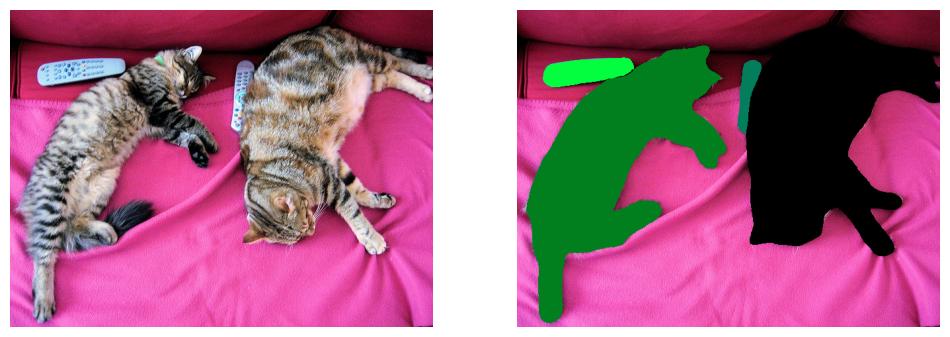
You can visualize the predicted masks like this:
import matplotlib.pyplot as plt
from torchvision.io import read_image
from torchvision.utils import draw_segmentation_masks

image = read_image("image.jpg")
image_with_masks = draw_segmentation_masks(image, results["masks"], alpha=0.6)
plt.imshow(image_with_masks.permute(1, 2, 0))
Data
LightlyTrain supports instance segmentation datasets in YOLO format. Every image must have a corresponding annotation file that contains for every object in the image a line with the class ID and (x1, y1, x2, y2, …) polygon coordinates in normalized format.
0 0.782016 0.986521 0.937078 0.874167 0.957297 0.782021 0.950562 0.739333
1 0.557859 0.143813 0.487078 0.0314583 0.859547 0.00897917 0.985953 0.130333 0.984266 0.184271
The following image formats are supported:
jpg
jpeg
png
ppm
bmp
pgm
tif
tiff
webp
Your dataset directory must be organized like this:
my_data_dir/
├── images
│   ├── train
│   │   ├── image1.jpg
│   │   ├── image2.jpg
│   │   └── ...
│   └── val
│       ├── image1.jpg
│       ├── image2.jpg
│       └── ...
└── labels
    ├── train
    │   ├── image1.txt
    │   ├── image2.txt
    │   └── ...
    └── val
        ├── image1.txt
        ├── image2.txt
        └── ...
Alternatively, the train/val splits can also be at the top level:
my_data_dir/
├── train
│   ├── images
│   │   ├── image1.jpg
│   │   ├── image2.jpg
│   │   └── ...
│   └── labels
│       ├── image1.txt
│       ├── image2.txt
│       └── ...
└── val
    ├── images
    │   ├── image1.jpg
    │   ├── image2.jpg
    │   └── ...
    └── labels
        ├── image1.txt
        ├── image2.txt
        └── ...
The data argument in train_instance_segmentation must point to the dataset directory
and specify the paths to the training and validation images relative to the dataset
directory. For example:
import lightly_train

if __name__ == "__main__":
    lightly_train.train_instance_segmentation(
        out="out/my_experiment",
        model="dinov3/vitl16-eomt-inst-coco",
        data={
            "path": "my_data_dir",      # Path to dataset directory
            "train": "images/train",    # Path to training images
            "val": "images/val",        # Path to validation images
            "names": {                  # Classes in the dataset
                0: "background",        # Classes must match those in the annotation files
                1: "car",
                2: "bicycle",
                # ...
            },
        },
    )
Model
The model argument defines the model used for instance segmentation training. The
following models are available:
DINOv3 Models
dinov3/vits16-eomtdinov3/vits16plus-eomtdinov3/vitb16-eomtdinov3/vitl16-eomtdinov3/vitl16plus-eomtdinov3/vith16plus-eomtdinov3/vit7b16-eomtdinov3/vits16-eomt-inst-coco(fine-tuned on COCO)dinov3/vitb16-eomt-inst-coco(fine-tuned on COCO)dinov3/vitl16-eomt-inst-coco(fine-tuned on COCO)
All models are pretrained by Meta and fine-tuned by Lightly.
Logging
Logging is configured with the logger_args argument. The following loggers are
supported:
mlflow: Logs training metrics to MLflow (disabled by default, requires MLflow to be installed)tensorboard: Logs training metrics to TensorBoard (enabled by default, requires TensorBoard to be installed)wandb: Logs training metrics to Weights & Biases (disabled by default, requires wandb to be installed)
MLflow
Important
MLflow must be installed with pip install "lightly-train[mlflow]".
The mlflow logger can be configured with the following arguments:
import lightly_train

if __name__ == "__main__":
    lightly_train.train_instance_segmentation(
        out="out/my_experiment",
        model="dinov3/vitl16-eomt-inst-coco",
        data={
            # ...
        },
        logger_args={
            "mlflow": {
                "experiment_name": "my_experiment",
                "run_name": "my_run",
                "tracking_uri": "tracking_uri",
            },
        },
    )
TensorBoard
TensorBoard logs are automatically saved to the output directory. Run TensorBoard in a new terminal to visualize the training progress:
tensorboard --logdir out/my_experiment
Disable the TensorBoard logger with:
logger_args={"tensorboard": None}
Weights & Biases
Important
Weights & Biases must be installed with pip install "lightly-train[wandb]".
The Weights & Biases logger can be configured with the following arguments:
import lightly_train

if __name__ == "__main__":
    lightly_train.train_instance_segmentation(
        out="out/my_experiment",
        model="dinov3/vitl16-eomt-inst-coco",
        data={
            # ...
        },
        logger_args={
            "wandb": {
                "project": "my_project",
                "name": "my_experiment",
                "log_model": False,        # Set to True to upload model checkpoints
            },
        },
    )
Resume Training
There are two distinct ways to continue training, depending on your intention.
Resume Interrupted Training
Use resume_interrupted=True to resume a previously interrupted or crashed training
run. This will pick up exactly where the training left off.
You must use the same
outdirectory as the original run.You must not change any training parameters (e.g., learning rate, batch size, data, etc.).
This is intended for continuing the same run without modification.
This will utilize the .ckpt checkpoint file out/my_experiment/checkpoints/last.ckpt
to restore the entire training state, including model weights, optimizer state, and
epoch count.
Load Weights for a New Run
As stated above, you can specify model="<checkpoint path"> to further fine-tune a
model from a previous run.
You are free to change training parameters.
This is useful for continuing training with a different setup.
We recommend using the exported best model weights from
out/my_experiment/exported_models/exported_best.pt for this purpose, though a .ckpt
file can also be loaded.
Exporting a Checkpoint to ONNX
Open Neural Network Exchange (ONNX) is a standard format for representing machine learning models in a framework independent manner. In particular, it is useful for deploying our models on edge devices where PyTorch is not available.
Requirements
Exporting to ONNX requires some additional packages to be installed. Namely
onnxruntime if
verifyis set toTrue.onnxslim if
simplifyis set toTrue.
You can install them with:
pip install "lightly-train[onnx,onnxruntime,onnxslim]"
The following example shows how to export a previously trained model to ONNX.
import lightly_train

# Instantiate the model from a checkpoint.
model = lightly_train.load_model("out/my_experiment/exported_models/exported_best.pt")

# Export the PyTorch model to ONNX.
model.export_onnx(
    out="out/my_experiment/exported_models/model.onnx",
    # precision="fp16", # Export model with FP16 weights for smaller size and faster inference.
)
See export_onnx() for all available options
when exporting to ONNX.
The following notebook shows how to export a model to ONNX in Colab:
Exporting a Checkpoint to TensorRT
TensorRT engines are built from an ONNX representation of the model. The
export_tensorrt method internally exports the model to ONNX (see the ONNX export
section above) before building a TensorRT
engine for fast GPU inference.
Requirements
TensorRT is not part of LightlyTrain’s dependencies and must be installed separately. Installation depends on your OS, Python version, GPU, and NVIDIA driver/CUDA setup. See the TensorRT documentation for more details.
On CUDA 12.x systems you can often install the Python package via:
pip install tensorrt-cu12
import lightly_train

# Instantiate the model from a checkpoint.
model = lightly_train.load_model("out/my_experiment/exported_models/exported_best.pt")

# Export to TensorRT from an ONNX file.
model.export_tensorrt(
    out="out/my_experiment/exported_models/model.trt", # TensorRT engine destination.
    # precision="fp16", # Export model with FP16 weights for smaller size and faster inference.
)
See export_tensorrt() for all available
options when exporting to TensorRT.
You can also learn more about exporting EoMT to TensorRT using our Colab notebook:
Default Image Transform Arguments
The following are the default train transform arguments. The validation arguments are automatically inferred from the train arguments.
You can configure the image size and normalization like this:
import lightly_train

if __name__ == "__main__":
    lightly_train.train_instance_segmentation(
        out="out/my_experiment",
        model="dinov3/vitl16-eomt-inst-coco",
        data={
            # ...
        }
        transform_args={
            "image_size": (640, 640),     # (height, width)
            "normalize": {
                "mean": [0.485, 0.456, 0.406],
                "std": [0.229, 0.224, 0.225],
            },
        },
    )
EoMT Instance Segmentation DINOv3 Default Transform Arguments
Train
{
    "bbox_params": "BboxParams",
    "channel_drop": null,
    "color_jitter": null,
    "image_size": "auto",
    "normalize": "auto",
    "num_channels": "auto",
    "random_crop": {
        "fill": 0,
        "height": "auto",
        "pad_if_needed": true,
        "pad_position": "center",
        "prob": 1.0,
        "width": "auto"
    },
    "random_flip": {
        "horizontal_prob": 0.5,
        "vertical_prob": 0.0
    },
    "scale_jitter": {
        "divisible_by": null,
        "max_scale": 2.0,
        "min_scale": 0.1,
        "num_scales": 20,
        "prob": 1.0,
        "seed_offset": 0,
        "sizes": null,
        "step_seeding": false
    },
    "smallest_max_size": null
}
Val
{
    "bbox_params": "BboxParams",
    "channel_drop": null,
    "color_jitter": null,
    "image_size": null,
    "normalize": "auto",
    "num_channels": "auto",
    "random_crop": null,
    "random_flip": null,
    "scale_jitter": null,
    "smallest_max_size": null
}
In case you need different parameters for training and validation, you can pass an
optional val dictionary to transform_args to override the validation parameters:
transform_args={
    "image_size": (640, 640), # (height, width)
    "normalize": {
        "mean": [0.485, 0.456, 0.406],
        "std": [0.229, 0.224, 0.225],
    },
    "val": {    # Override validation parameters
        "image_size": (512, 512), # (height, width)
    }
}